Crystal Healing: A Beginner's Guide to Stones and Meanings
Crystals have been used for healing across cultures for centuries. Learn what crystal healing is, how to choose your first stones, and how to use them daily.
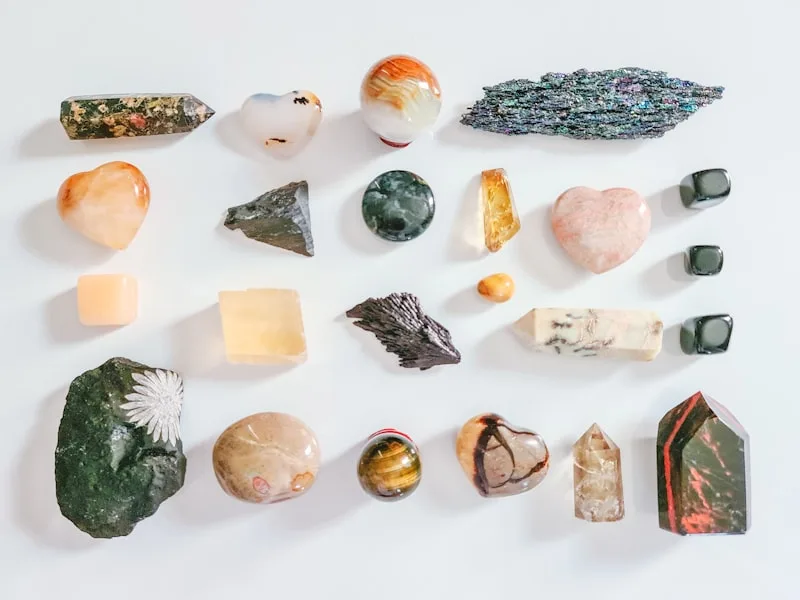
Crystal healing is the practice of placing stones on or around the body to influence physical, emotional, or energetic states. It is not new. It is not a wellness trend invented by Instagram. The use of stones for healing appears in ancient Egyptian medicine, in traditional Chinese stone therapy, in Ayurvedic practice, and in the folk medicine traditions of every inhabited continent.
This guide covers what crystal healing actually involves, how to choose and care for your first stones, and where the practice fits alongside the five elements system of traditional Chinese philosophy.
What crystal healing is
Crystal healing operates on the premise that stones and minerals carry stable vibrational frequencies, and that placing certain stones near the body can help restore balance to disrupted energy patterns. This premise is not testable with current scientific instruments in a way that satisfies the standards of randomized controlled trials. That is the honest version.
What is observable: people who work with crystals report feeling calmer, more focused, less anxious, and more connected to their intentions. Whether this is the crystal’s frequency, the placebo effect, the focused attention of ritual, or all three interacting at once, the outcome is what matters. Crystals are tools for attention. A crystal you hold during meditation is a physical anchor for a mental state.
For the Chinese philosophical perspective on how physical objects carry and transmit energy, the five elements guide provides the theoretical framework.
The seven essential beginner stones
You do not need a collection of fifty crystals. Five to seven stones, chosen with intention, cover the full range of what a beginner needs. Here are the seven stones that appear in every culture’s crystal tradition for good reason.
1. Clear quartz: the amplifier
Clear quartz is the most versatile stone in any collection. It is believed to amplify whatever energy or intention it is placed near. If you hold clear quartz during a meditation on clarity, it amplifies clarity. If you hold it while you are anxious, it amplifies anxiety. This is why clear quartz responds well to intentional use and poorly to mindless carrying. Set an intention before you pick it up.
Use clear quartz at your desk for focus, on your nightstand for dream clarity, or held during any practice where you want the effect of the practice intensified. Cleanse it regularly. It picks up everything.
2. Amethyst: the calmer
Amethyst is the stone for stillness. Its purple color, historically associated with royalty and spiritual authority, matches its reputation as a stone that quiets mental noise. Place amethyst in the bedroom, in a meditation corner, or near the bathtub. It is not a stone for the gym or the office.
Amethyst is most useful when your mind will not settle. A piece of amethyst held during a breathing exercise gives your hands something to do and your attention somewhere to rest that is not a screen. That alone is a useful function.
3. Rose quartz: the heart stone
Rose quartz is associated with the heart: self-love, romantic love, forgiveness, emotional repair. It is the stone people reach for after a breakup, during grief, or when self-criticism has become a reflex. The pale pink color is part of its effect. The visual gentleness of the stone reinforces the emotional gentleness it is meant to cultivate.
Place rose quartz in the relationship area of your home (southwest, by the classical bagua). Carry a small piece in a pocket if you are going into a difficult emotional situation. Do not expect rose quartz to fix a relationship that needs a conversation. The stone supports the work. It does not replace it.
4. Black tourmaline: the protector
Black tourmaline is the stone for energetic boundaries. It is believed to absorb and neutralize negative energy from the environment. Practitioners place it near the front door, on a desk in a stressful workplace, or carry it when dealing with difficult people.
Black tourmaline is heavy, opaque, and grounding. It feels like a shield because it looks like one. If clear quartz amplifies what is present, black tourmaline blocks what should not enter. The two stones are often paired: tourmaline at the door, quartz at the desk.
5. Citrine: the abundance stone
Citrine is associated with prosperity, confidence, and creative energy. Its yellow-to-golden color links it to the solar plexus and to the fire element. Where amethyst pulls inward, citrine pushes outward.
Place citrine in the wealth area of your home (southeast, by the bagua) or on your desk where you handle money. Cash boxes, invoice folders, anywhere financial energy moves through your home, citrine belongs nearby. It is also a useful stone for public speaking or any situation where you need to project warmth and authority at the same time.
6. Selenite: the cleanser
Selenite is a soft white stone that is believed to cleanse other crystals of accumulated energy. It does not need cleansing itself, which makes it unique. Keep a selenite wand or plate on your crystal storage surface. Place other stones on it overnight to reset them.
Selenite also works as a standalone calm-presence stone. Its white color and striated surface make it visually restful. A piece of selenite on a nightstand or in a meditation space adds stillness without adding visual weight.
7. Hematite: the grounder
Hematite is iron-heavy, dense, and grounding. It is the stone for when you feel scattered, unmoored, or mentally fragmented. Holding hematite during a stressful meeting or carrying it in a pocket on a chaotic day gives the nervous system a weighted focal point.
Hematite is also practical. It is nearly indestructible, cheap, and easy to find. If you buy exactly one stone, make it hematite. It asks nothing and delivers a reliable grounding effect.
How to choose a crystal
Do not buy crystals online based on photos alone if you can avoid it. Go to a shop. Pick up stones. The one that feels right in your hand is the one to take home. This is not mysticism. Your nervous system responds to tactile qualities — weight, temperature, texture, shape — in ways your conscious mind does not process. A stone that feels right is a stone you will actually use.
If you must buy online, start with clear quartz or hematite. They are hard to fake, hard to damage, and useful regardless of your needs. Amethyst and rose quartz also have few convincing imitations at the beginner price range. Avoid expensive stones until you know enough to verify authenticity.
Cleansing and charging
Crystals accumulate energy from the environments and emotional states they are exposed to. A crystal that has been on your desk during a stressful week needs to be reset before it is useful again. Think of it like washing a dish. The dish did nothing wrong. It just needs to be clean before you use it again.
Four standard methods:
- Moonlight: Place stones on a windowsill during a full moon. Leave them overnight. This is the gentlest method and works for all stones.
- Running water: Hold the stone under cool running water for 30 to 60 seconds. Do not do this with selenite or hematite. Both degrade in water.
- Salt: Bury stones in dry sea salt overnight. Dispose of the salt afterward. Do not reuse it for cooking. Do not use salt with porous stones.
- Selenite: Place stones on a selenite plate or next to a selenite wand for 6 to 8 hours. This is the method that works for all stones without risk of damage.
Cleanse new stones before first use. They have been handled by multiple people between the mine and your hand. Cleanse stones after intense emotional work, after illness, or when they no longer feel energetically clean — a subjective measure, but one you will learn to recognize.
Charging stones with intention
After cleansing, hold the stone in your dominant hand. State your intention for it, silently or aloud. Be specific: not “make me happy” but “help me stay calm during the presentation tomorrow.” The stone is not a wishing device. It is a focus tool. A clear intention gives the stone a temporary job. When that job is done, cleanse the stone and set a new intention or let it rest.
Crystals and the five elements
The Chinese five elements system maps neatly onto crystal work. Each element has stones that express its energy:
- Wood (growth, expansion): green aventurine, moss agate, malachite. Use for new projects, personal growth, spring energy.
- Fire (passion, transformation): citrine, carnelian, red jasper. Use for confidence, creative work, motivation.
- Earth (stability, nourishment): hematite, tiger’s eye, smoky quartz. Use for grounding, routine, feeling safe in your body.
- Metal (clarity, precision): clear quartz, selenite, pyrite. Use for focus, decision-making, mental sharpness.
- Water (emotion, intuition): amethyst, moonstone, lapis lazuli. Use for emotional processing, dream work, creative reflection.
A beginner’s kit can cover all five elements with five stones: green aventurine (wood), citrine (fire), hematite (earth), clear quartz (metal), amethyst (water). This set lets you work with whichever element you need to strengthen on a given day.
For a full explanation of how the elements generate, control, and balance each other, read the five elements complete guide.
Where to place crystals in your home
Crystal placement follows the same spatial logic as feng shui. Match the stone’s purpose to the room’s function and the bagua area:
- Front entry: black tourmaline or hematite for protection. The first energy that enters your home passes these stones.
- Living room: citrine or clear quartz for social warmth and amplified positive energy.
- Bedroom: amethyst or rose quartz for calm and emotional restoration. Keep crystals across the room from the bed, not directly on the bedside table. The bedroom is for rest. Crystals are mildly active by nature.
- Home office: clear quartz for focus, citrine for creative work, hematite for grounding during stressful calls.
- Wealth area (southeast, bagua): citrine, pyrite, or green jade. The classic prosperity placement.
Check your floor plan against the bagua map guide to identify the exact areas in your home.
Crystals are not a substitute
Crystals can support mental health. They cannot replace therapy, medication, or medical treatment. If you are experiencing depression, anxiety, or any condition that affects your daily functioning, a crystal is not the intervention. It is a complement at best. The person who benefits most from crystal work is the person who is already doing the other work: therapy, exercise, sleep hygiene, honest conversations. Crystals amplify what is present. If what is present is neglect, a crystal will not fix it.
Start small. One stone. One intention. One week. See what changes. If nothing changes, you spent ten dollars on a beautiful rock you can keep on your desk. There are worse outcomes.